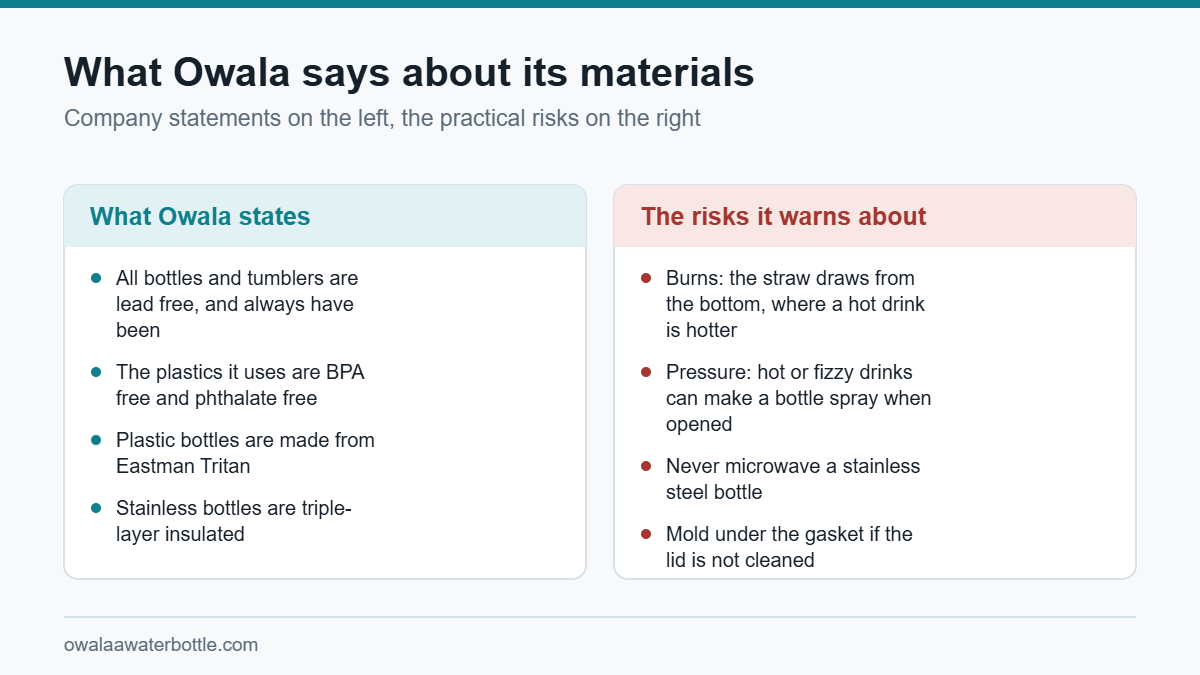
Owala says all its bottles and tumblers are and always have been lead free, and that its plastics are BPA and phthalate free. The safety risks it warns about most are practical ones: pressure from hot or fizzy drinks and burns from hot liquids. Carolina Arey, last reviewed September 30, 2026.
As an Amazon Associate we earn from qualifying purchases.
This page reports Owala’s own statements and cites them. We have not run lab tests on these bottles.
What Owala says about lead
Owala’s FAQ states that all its bottles and tumblers, including the FreeSip, are lead free and have been from the start. It says it used a lead-free solder in its products from the beginning. The statement was published as media attention on lead in tumblers grew, and Owala says it stands by its safety record. If lead is a concern for you, ask Owala for its test details; its FAQ says the bottles are tested and invites customers to contact it for details.
BPA, phthalates and plastic
| Material | What Owala says |
|---|---|
| Plastics used in Owala products | BPA free and phthalate free |
| Plastic bottles (Eastman Tritan) | Made from Tritan; not for hot, carbonated or perishable liquids |
| Stainless steel bottles | Triple-layer insulated stainless steel |
Sources: Owala FAQ and Owala FreeSip page. We could not find Owala publishing the exact stainless steel grade on the pages we read, so this guide does not state one.
Real safety risks and how to avoid them
- Burns. Owala warns that hot liquids can cause injury, and that the straw pulls liquid from the bottom, where a hot drink is hotter. Use hot drinks only in approved models, and never with scalding liquid. See Can you put hot drinks in an Owala?
- Pressure. Hot, carbonated and perishable drinks can build pressure that makes a bottle leak, spray or snap the spout cover open. Owala’s advice: open with caution and keep fingers away from the recess behind the spout cover.
- Microwaving. Owala says never to microwave stainless steel bottles and strongly discourages it for plastic ones.
- Dirty lids. Mold and residue collect under the spout gasket. Clean the lid regularly; see how to clean an Owala and Owala mold and smell.
- Accidental opening. Cover the button with the carry loop or lock so the lid does not open in a bag.
Is Owala safe for kids?
The Kids’ FreeSip follows the same rules as the FreeSip: Owala says not to use it for hot, carbonated or perishable liquids. Its lid has small parts, the straw and the gasket, so wash them daily or every couple of days and make sure a child cannot pull the gasket out. Owala’s kids’ cleaning guide calls the gasket a germ and mold trap if it is not cleaned often. For the model that fits your child, see Owala kids’ bottles.
Warranty and returns
Owala says it stands behind its bottles and takes warranty claims for manufacturing issues; it does not cover accidental damage, improper care or misuse, or normal wear and tear. Unused bottles in their original packaging can be returned for a refund within 30 days of purchase. See Owala warranty once that page is live.
FAQ
Is Owala BPA free?
Owala says the plastics it uses are BPA and phthalate free.
Is Owala lead free?
Owala says yes, all bottles and tumblers, and that they always have been.
Are Owala bottles tested?
Owala’s FAQ says it would not sell untested products and invites customers to contact it for details.
Is Owala safe for hot drinks?
Only in the models Owala approves, and with care.
Is Owala safe to microwave?
No.
Related guides: What can you put in an Owala?, Can you put hot drinks in an Owala?, Is an Owala dishwasher safe?, Why is my Owala leaking?
Sources: Owala FAQ, Owala FreeSip page, Owala: how to clean the Kids’ FreeSip